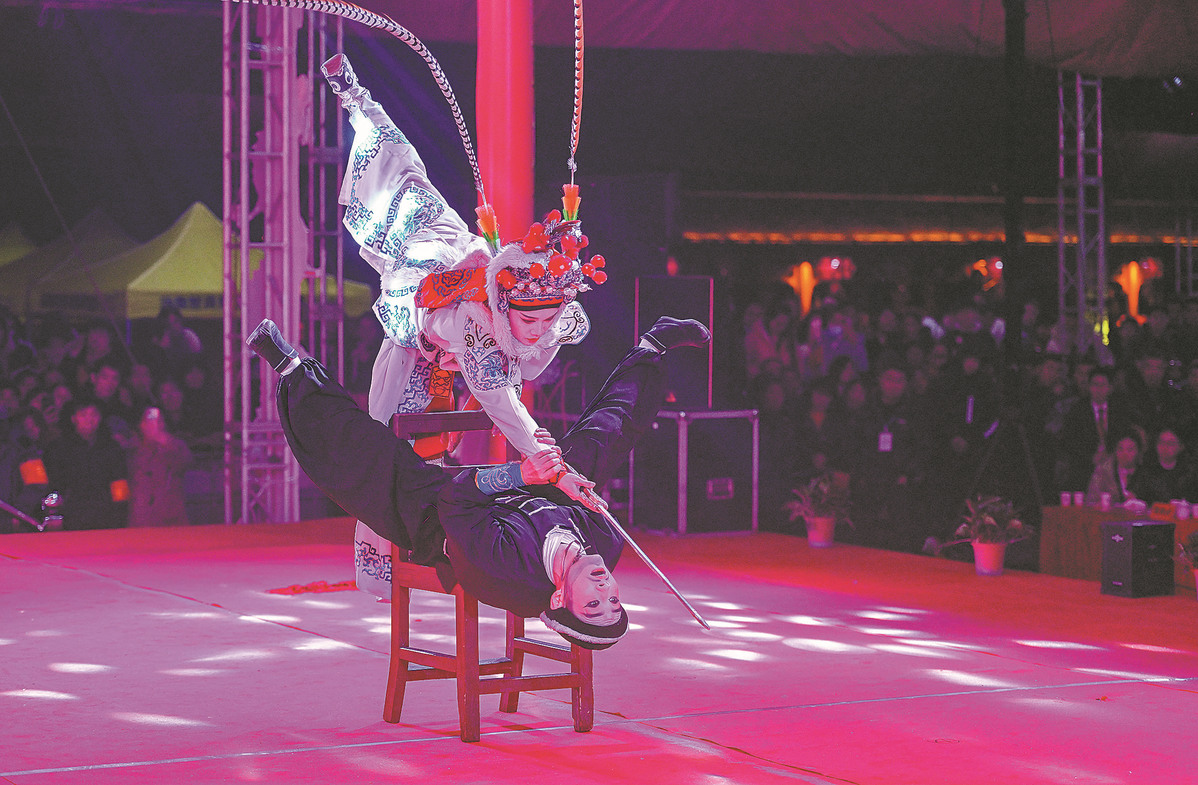
Flower Drum Opera
Introduction
The Flower Drum Opera, originally known as a folk singing and dancing mode, has evolved into a significant form of traditional Chinese opera. As Flower Drum Opera takes rural life as the subject matter and its melody is stemmed from ballads, folk songs, hums, work songs and Taoist music, it is featured by lively melody, pithy plot and dialect-style singing.
Performing forms of Flower Drum Opera were fixed in the Qing Dynasty (1644-1911) to be cored with three roles: Dan (the female character type), Sheng (the young male character type) and Chou (clown).
Historical Development
The roots of Flower Drum Opera can be traced back to the Ming (1368-1644) and Qing dynasties when it was primarily performed as folk drama consisting of two-role and three-role playlets. The two-role playlet typically featured the Xiaodan and Xiaochou roles, while the three-role playlet added a Xiaosheng (young handsome male).
Regional Variants
Flower Drum Opera is a local opera originated in the countryside of many regions. Its main accompaniment instruments include suona, pipe, drum, gong, etc. Flower Drum Opera is very popular with the local people in Hunan, Hubei, Anhui, Guangdong and other provinces.
Cultural Themes and Repertoire
The repertoire of Flower Drum Opera is extensive, featuring around 500 plays passed down through generations. Many of these plays draw their themes from folklore and rural life, with adaptations from myths, legends, folk stories and other local operas.
The most typical Hunan Flower-drum Opera has been developed for over 200 years and now is provided with more than 300 types of melodies. Moreover, a large number of traditional repertoires such as Woodcutter Liuhai and Liuhai Playing with Gold Hoptoad have been coordinated and adapted. At the same time, numerous modern dramas such as the popular play Tinker Pans were created. The initial heroine of the play is the later famous soprano singer Li Guyi.
Modern Influences and Performances
As a playlet taking root in folk life, Flower Drum Opera has been experiencing continuous improvement under the joint efforts of old and newly-arising artists.
In recent years, Flower Drum Opera has found new audiences through modern media platforms. Troupes have used social media platforms such as Douyin to broadcast their performances, attracting significant follower bases and reviving interest in traditional art forms. This digital presence has allowed Flower Drum Opera to reach a broader audience, ensuring its survival and continued relevance in contemporary culture.
Community and Cultural Significance
Beyond being a form of entertainment, Flower Drum Opera plays a crucial role in cultural heritage and community identity. It connects audiences with the past, providing a cultural bridge that links traditions with modern artistic expressions. Festivals and events celebrating Flower Drum Opera further promote its cultural significance, drawing enthusiasts and practitioners to partake in the shared cultural experience.








